
The Lednice Minaret: A Unique Lookout Tower in the Castle Park
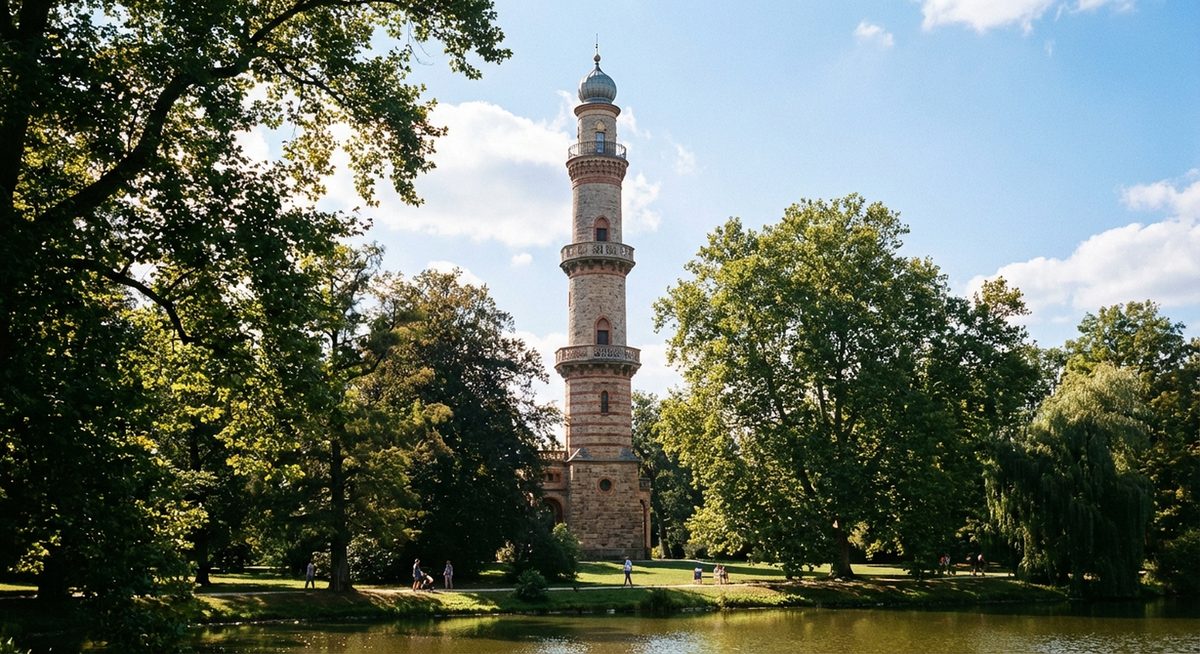
Rising 60 metres above the treetops of the Lednice Castle park, the Lednice Minaret is one of the most extraordinary architectural follies in all of Europe. Built at the turn of the 19th century in an exotic Moorish-Gothic style, it is widely recognised as the tallest non-Islamic minaret in the world. This slender, octagonal tower offers visitors who climb its 302 steps a breathtaking panoramic view stretching across the flatlands of South Moravia, into neighbouring Austria, and on clear days as far as the White Carpathians.
History of the Lednice Minaret
Commission and Construction (1797–1802)
The minaret was commissioned by Prince Alois I of Liechtenstein, a cultured and well-travelled aristocrat with a deep fascination for Oriental art and architecture. At a time when wealthy European landowners competed to fill their estates with romantic and exotic garden structures, Alois I envisioned something truly without precedent: a full-scale minaret, complete with a gallery and viewing platform, set within his English landscape park at Lednice.
The prince entrusted the design to Josef Hardtmuth, an architect and inventor best known today as the founder of the Koh-i-Noor pencil company and the inventor of the modern graphite pencil. Hardtmuth created an ambitious design blending Moorish arches, Islamic geometric patterns, and Gothic structural elements. Construction began in 1797 and was completed in 1802, requiring five years of meticulous work and considerable expense.
Controversy and Opposition
The construction of the minaret was not without controversy. Local Catholic clergy objected strongly to the erection of what they considered an Islamic religious structure on Christian soil. The dispute escalated to the point where Prince Alois I had to petition Emperor Franz I personally for permission to complete the tower. The emperor ultimately sided with the prince, allowing the project to proceed. According to legend, when the clergy refused to build a church on the prince's land, he decided to build a minaret instead — a characteristically bold response that demonstrates the remarkable independence and determination of the Liechtenstein family.
Later History and Restoration
After the confiscation of Liechtenstein properties in 1945, the minaret came under state care. It was declared a national cultural monument and has since undergone several rounds of restoration, most recently in the early 2000s, to preserve its ornamental stonework, decorative plaster, and internal structure. Today it stands as one of the most iconic landmarks of the Lednice-Valtice Cultural Landscape and a key component of the UNESCO World Heritage Site.
Architecture and Design
The minaret stands approximately 60 metres tall and is built on an octagonal ground plan. The lower section features a broad base with an arcaded gallery adorned with pointed Moorish arches and decorative stone carvings inspired by Islamic geometric motifs. Above this, the slender tower shaft rises in elegant stages, punctuated by narrow windows and decorative string courses. Three balconied galleries encircle the tower at different heights, each offering progressively wider views of the surrounding landscape.
The interior contains a spiral staircase of 302 steps that winds upward through the tower to the observation gallery near the summit. The staircase is relatively narrow and can be physically demanding, but the reward at the top is one of the finest views in the region.
At the base of the minaret, three ground-floor rooms once served as reception salons and are decorated with Oriental-style wall paintings and ornamental plasterwork. These rooms are included in the standard visit and provide context for the building's exotic aesthetic inspiration.
Good to Know
The 302 steps to the top are steep and narrow. The climb is not recommended for visitors with mobility difficulties, claustrophobia, or severe vertigo. Wear comfortable shoes and allow about 30–45 minutes for the complete visit including the ascent, time at the viewing platform, and descent.
The View from the Top
The observation gallery at the top of the minaret offers a 360-degree panoramic view that is among the most rewarding in South Moravia. On a clear day, you can see:
- The entire Lednice Castle complex and its sprawling English park
- The Dyje River winding through the floodplain forests
- The town of Břeclav to the east
- Valtice Castle and its surroundings to the southwest
- The Pálava Hills and their dramatic limestone ridges on the horizon
- The flatlands of Lower Austria across the border to the south
- On exceptionally clear days, the silhouettes of the White Carpathians to the northeast
The viewing platform has information panels identifying the landmarks visible in each direction, making it easy to orient yourself even without a map.
Admission Prices 2026
| Ticket Type | Price (CZK) | Price (EUR approx.) |
|---|---|---|
| Adult | 120 CZK | ~5 € |
| Reduced (students, seniors) | 80 CZK | ~3 € |
| Children 6–15 | 60 CZK | ~2.50 € |
| Children under 6 | Free | Free |
| Family ticket (2 adults + 2 children) | 300 CZK | ~12 € |
Tickets are purchased at the entrance to the minaret. Card payments may not be accepted — bring Czech crowns in cash to be safe.
Opening Hours 2026
| Period | Days Open | Hours |
|---|---|---|
| April | Sat – Sun | 10:00 – 16:30 |
| May – June | Tue – Sun | 9:00 – 17:00 |
| July – August | Daily | 9:00 – 18:00 |
| September | Tue – Sun | 9:00 – 17:00 |
| October | Sat – Sun | 10:00 – 16:00 |
| November – March | Closed | — |
Last admission is 30 minutes before closing. The minaret may close during storms or high winds for safety reasons without prior notice.
How to Get There
The minaret is located in the eastern part of the Lednice Castle park, about a 15–20 minute walk from the castle itself along a pleasant path through the landscaped gardens. Follow the signed trail from the castle courtyard eastward along the fishponds. The path is flat and suitable for pushchairs, though the minaret itself is not wheelchair accessible.
You can also reach the minaret by boat during the summer months — one of the cruise routes passes close by, with a stop that allows you to disembark and visit the tower before continuing your cruise or walking back through the park.
By bicycle, the minaret is easily accessible along the park's cycling paths. Bicycle parking is available near the tower entrance.
Frequently Asked Questions
How many steps does the Lednice Minaret have?
The minaret has 302 steps from ground level to the observation gallery. The staircase is a continuous spiral and there are no lifts or alternative access routes.
How tall is the Lednice Minaret?
The minaret stands approximately 60 metres (197 feet) tall, making it the tallest non-Islamic minaret in Europe and one of the tallest garden follies on the continent.
Is the minaret suitable for children?
Children who are comfortable with climbing stairs can visit the minaret. However, the staircase is narrow and steep, so young children should be supervised at all times. The viewing platform has safety railings but can feel exposed for those nervous of heights.
Can I visit the minaret in winter?
No, the minaret is closed from November through March. The first opening of the season is typically in April on weekends only, with full opening from May onward.
Is there an entrance fee for the castle park?
No. The castle park is free to enter year-round. You only pay for admission to the minaret itself when you want to enter the interior and climb the tower.
How long does it take to visit the minaret?
Allow approximately 30–45 minutes for the complete visit. This includes viewing the ground-floor rooms, climbing the 302 steps, spending time at the observation gallery, and descending. Add 15–20 minutes each way for the walk from Lednice Castle.
Is the minaret a real mosque?
No. The minaret was built purely as a decorative garden folly and lookout tower. It has never served any religious function. Its Moorish-Gothic style reflects the 18th-century European fashion for exotic and Oriental-inspired garden architecture.
Can I take photos from the top?
Yes, photography is freely permitted at the observation gallery and throughout the exterior. Bring your camera — the views are exceptional and well worth capturing, especially during golden hour in the late afternoon.
Is the minaret part of the UNESCO World Heritage Site?
Yes. The minaret is one of the key structures within the Lednice-Valtice Cultural Landscape, inscribed on the UNESCO World Heritage List in 1996. It is considered one of the most remarkable examples of Romantic-era garden architecture in Central Europe.
Are there other follies in the park worth visiting?
Absolutely. The Lednice park contains numerous other follies and garden structures, including the Temple of Apollo, the Roman Aqueduct, the Temple of the Three Graces, Jan's Castle (Janův hrad), and the Palm Greenhouse. Each is unique and contributes to the extraordinary character of this designed landscape.